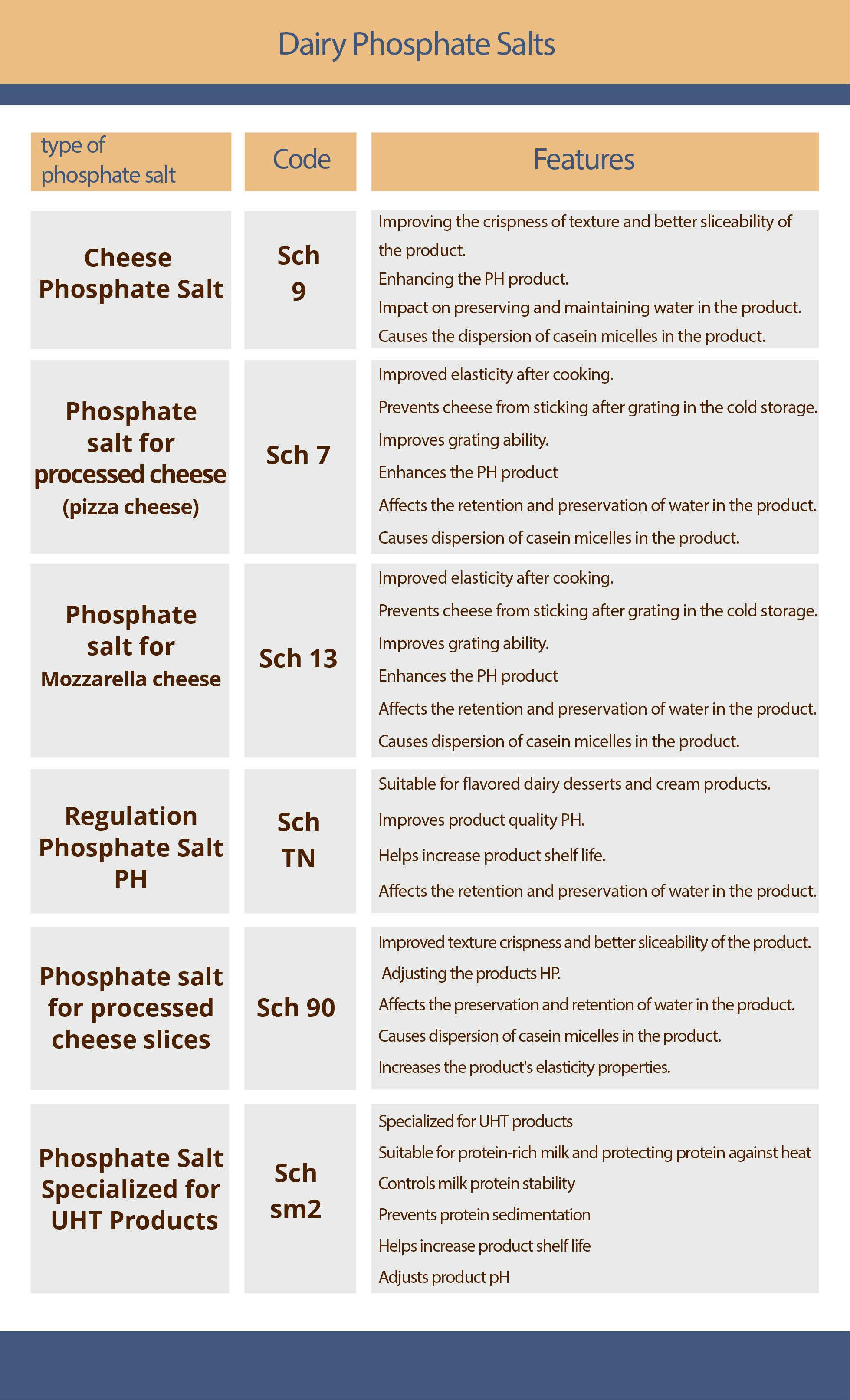
Phosphates are phosphoric acid salts. The most common types of emulsifying salts used in the industry are trisodium citrate, disodium phosphate, etc. Their important role is to strengthen the emulsification capability of cheese proteins by removing calcium from caseins, hydration, and protein dispersion. Different combinations of phosphate salts change the degree of hardness in processed cheeses.
Citrates and phosphates are groups of emulsifying salts that form a soluble metal complex with polyvalent Ca+2 and Mg+2 ions. Adding these salts to milk causes the dispersion of casein micelles by reducing the amount of ionized calcium and colloidal calcium phosphate. Some researchers believe that although phosphates and citrates are groups of emulsifying salts, these salts are not real emulsifiers, rather, through changes they apply in the structure of casein, they make changes in the water holding capacity of proteins in gel structure and the fat emulsifying capacity via casein.